
RESISTED SLED SPRINTS: THE SCIENCE OF FASTER ACCELERATION
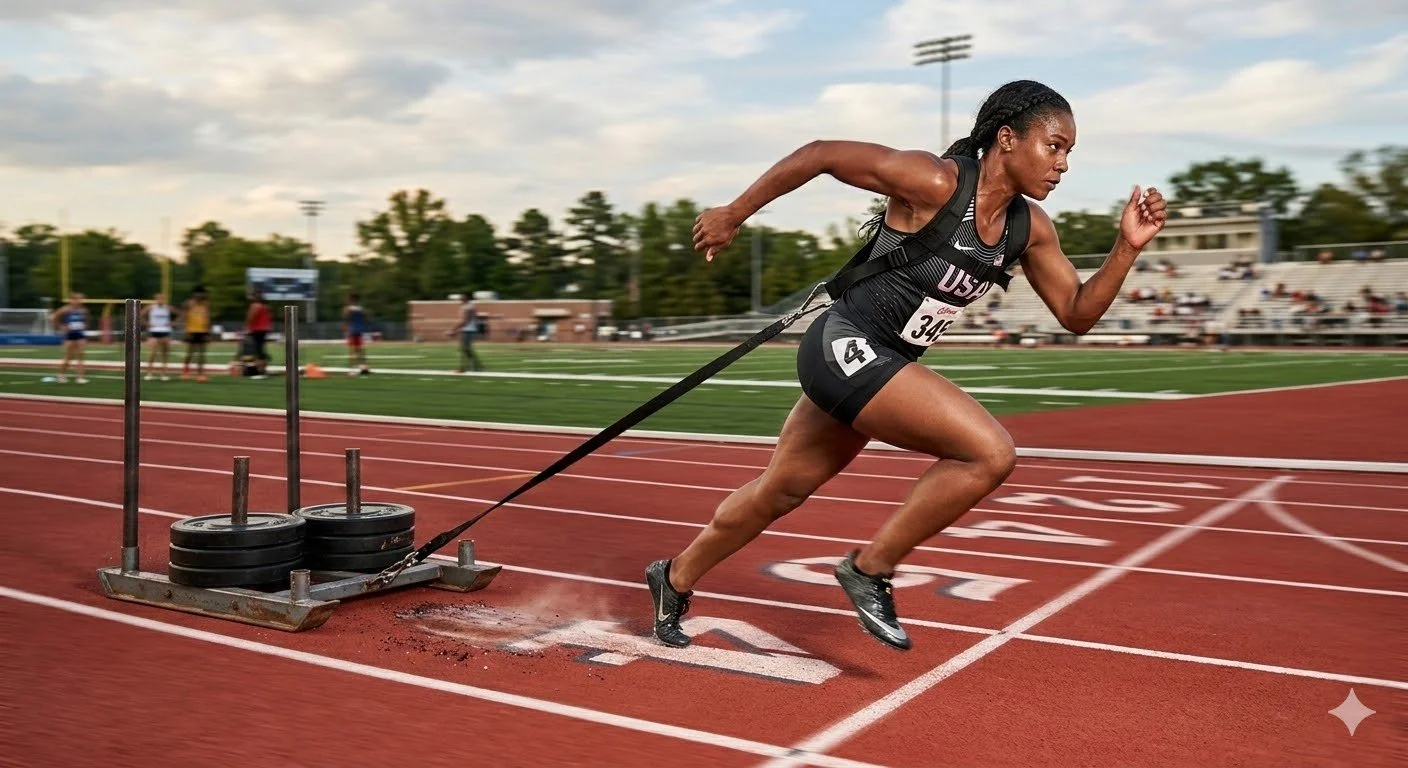
THE FIRST 20 METRES WIN EVERYTHING
It doesn't matter whether you're a winger reading a gap, a midfielder chasing a loose ball, or a sprinter leaving the blocks — athletic contests are decided in a window of roughly two seconds and twenty metres. What happens in that window is almost entirely determined by your acceleration. Resisted Sled Training (RST) has become one of the most well-supported tools for developing exactly that quality. The evidence is consistent across sports and populations: sled training improves acceleration, and heavier loads produce the greatest gains. Here's what the science shows, and how to put it to work.
THE EVIDENCE: WHAT THE RESEARCH ACTUALLY SHOWS
A 2023 randomised controlled trial with team sport athletes found that resisted sled training was superior to unresisted sprint training for improving acceleration over just 8 weeks. A separate U.S. Army study produced similar findings — resisted sled pushing outperformed unresisted training regardless of the load used. Crucially, both studies focused on short-distance sprint performance — the 0–20m range that matters most in sport. For sprinters, this is the drive phase off the blocks. For team sport athletes, it's the first burst past a defender or into open space. Key numbers at a glance: - 8 weeks to measurable acceleration gains - >10% body mass load for best results - 0–20m is the critical acceleration window
THE MECHANISM: WHY SLEDS WORK
Horizontal Force Production During acceleration, the limiting factor isn't raw leg strength — it's your ability to apply force horizontally into the ground. The sled forces you to do exactly that. By creating resistance directly against your forward movement, it trains your body to push back rather than just push down, building the specific neuromuscular pattern that drives faster starts. Acceleration Mechanics Heavy sled work also improves the body's positioning during the drive phase — forward lean, shin angle, hip extension. For sprinters, this means cleaner block mechanics. For team sport athletes, it means a more powerful first step off a standing or reactive start. The sled isn't just a strength tool; it's a technique tool. Heavier Loads, Greater Gains The research is consistent: loads greater than 10% of body mass produce greater gains in short-distance sprint performance than lighter loads. A combined approach — mixing heavy and light sled work across training blocks — has also proven effective, which makes sled training easily periodisable alongside your existing programme.
PROGRAMMING: HOW TO PROGRAMME IT
The principles are simple. Execution is where most athletes go wrong — either overloading too soon, neglecting recovery, or using distances that compromise technique. Load Start at 10–15% of body mass for acceleration-focused work. For an 80kg athlete, that's 8–12kg on the sled. Heavier loads (above 10% BM) consistently outperform lighter loads for short-sprint improvement. Distance Keep sets to 15–30 metres. Short enough to maintain proper drive-phase mechanics; long enough to generate a real stimulus. Going longer risks technical breakdown and shifts the demand away from acceleration. Recovery Allow 48–72 hours between intensive sled sessions. This is CNS-demanding work, and inadequate recovery will blunt adaptation and increase injury risk. Frequency 2–3 sessions per week during the off-season. Reduce to 1–2 during the competitive period to maintain quality without accumulated fatigue.
SPORT-SPECIFIC APPLICATION: PROGRAMMING BY ATHLETE TYPE
The loading principles are the same — but how you fit sled work into your week depends on your sport's demands. Team Sport Athletes - Place sled sessions on speed days, away from match day - Prioritise mid-week when tissue is recovered - Reduce volume in-season, maintain intensity - Pair with reactive sprint work to mimic game demands - Focus: explosive first step from standing or reactive starts Sprinters - Integrate into early-phase speed development blocks - Use heavy loads in GPP; shift lighter in SPP - Film drive-phase mechanics — sled should reinforce lean - Pair with block starts and flying sprints in the same session - Focus: drive phase mechanics and horizontal force output
SAMPLE OFF-SEASON TRAINING WEEK
Monday | Sled sprints: 6 x 20m @ 12% BM | Full recovery between reps (3–4 min) Wednesday | Heavy sled pulls: 4 x 15m @ 15% BM | Focus on forward lean and drive mechanics Friday | Light sled sprints: 6 x 25m @ 8% BM | Higher velocity; maintain acceleration posture Adjust load and volume based on training phase, athlete maturity, and in-season commitments.
THE BOTTOM LINE
1. Resisted sled training is scientifically proven to improve acceleration in the 0–20m range — the phase that matters most in team sport and track sprinting. 2. Use loads greater than 10% of body mass for the greatest short-sprint gains. Start conservative and build over weeks. 3. Keep sprint distances between 15–30m to preserve the drive-phase mechanics you're trying to reinforce. 4. Train 2–3 times per week off-season with 48–72 hours recovery between sessions. Drop volume (not intensity) in-season. 5. Team sport athletes should position sled sessions away from match day. Sprinters should integrate into drive-phase development blocks alongside block work.
REFERENCES
1. Alcaraz PE, et al. (2018). The effectiveness of resisted sled training (RST) for sprint performance: A systematic review and meta-analysis. Sports Med, 48(9):2143–2165.
2. Spiering BA, et al. (2023). The Effects of Heavy Resisted Sled Pulling on Sprint Mechanics and Spatiotemporal Parameters. J Strength Cond Res, 37(12):2346–2353.
3. Moreno D, et al. (2023). Efficacy of Resisted Sled Sprint Training Compared With Unresisted Sprint Training on Acceleration and Sprint Performance in Rugby Players: An 8-Week Randomized Controlled Trial. PubMed.
4. Harper D, et al. (2019). Influence of resisted sled-push training on the sprint force-velocity profile of male high school athletes. PubMed.
